A letter from Liguria
No. 5

I am writing from a different mountain. The dolomitic Monte Toraggio dominates the top of the most westerly valley in the Ligurian province of Imperia, standing at 1,973 metres on the border with France. Taking the old cobbled donkey track up the mountain, past wayside shrines still tended by local families, mobile phones play service provider ping pong—incoming text messages welcoming walkers first to France, then to Italy, and back again. Historically, the local territory has experienced a similar exchange of hands; the area has been transferred between France and Italy over the centuries, and links with Monaco, just ninety minutes away, remain particularly strong. The car park in the half-abandoned village at the base of the mountain is often full of vehicles bearing Monaco plates; local families who divide their time between the two places, spending summers in the Ligurian Alps and tending their ancestral olive groves dotted around the valley. Wandering through the silent vicoli (alleyways) and into the piazza of crumbling houses and a beautiful but faded pink church, the glamour and wealth of Monte Carlo is a world away. This is not the Liguria of the Cinque Terre and Gulf of Poets, teeming with tourists, sun beds, and sailboats. It is the hinterland, home to generations of tough highlanders, whose isolated mountains and forests provided shelter and battleground for gangs of partisans during the Second World War. As inhabitants departed for opportunities on the coast in the eighty years since the war ended, this village and others like it have become increasingly quiet and rough around the edges, colonised by feral cats and suspended in the aspic of time. Perhaps that is why this village is so cherished by the families who still come here—it is the antithesis of the capitalist mindset, a literal and metaphorical breath of fresh mountain air.
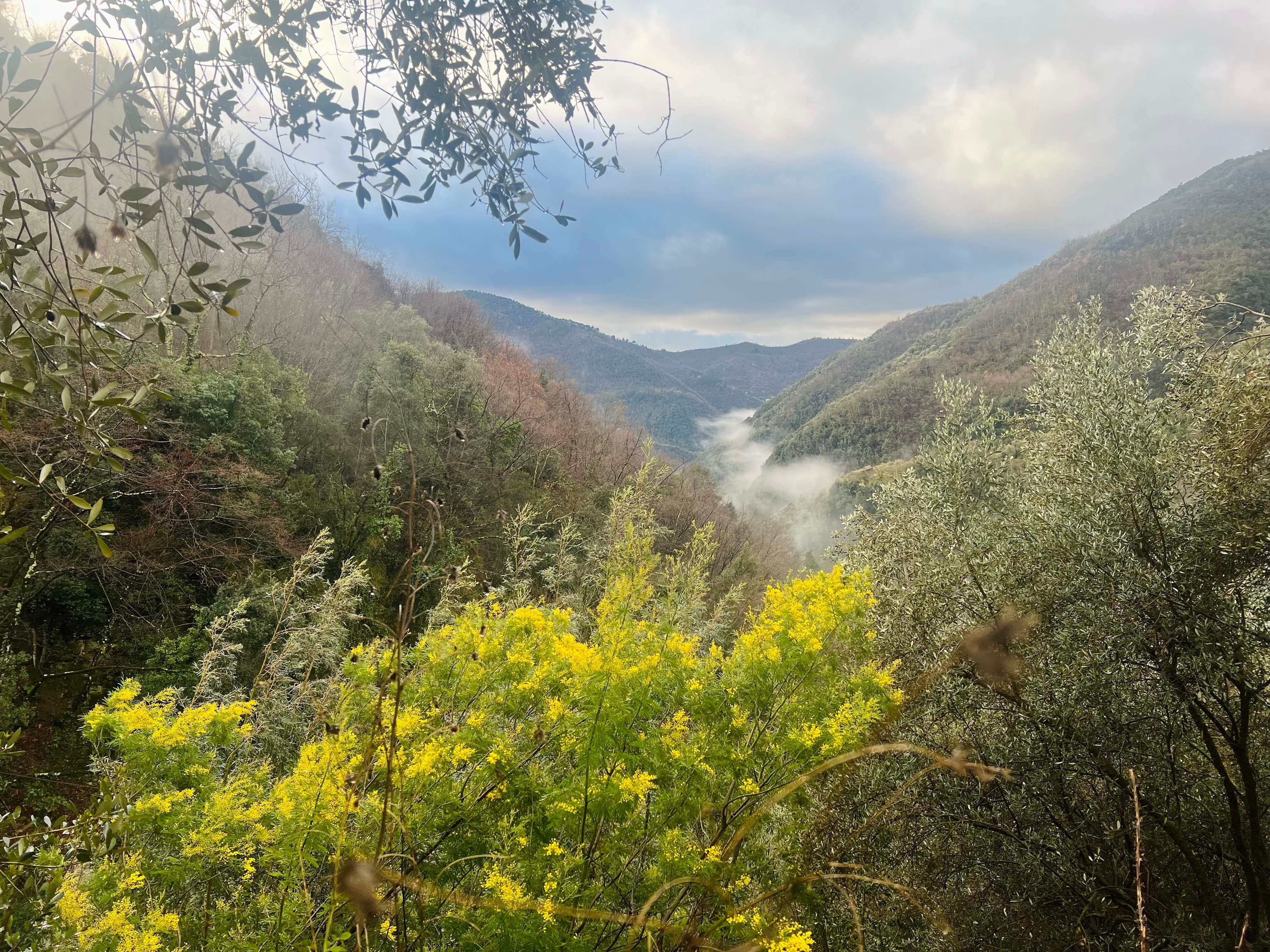
The Ligurian Alps carry an entirely different essence to my corner of the Cottian Alps further north since this is where the Alps meet the Mediterranean —the climate here is humid subtropical with sultry, almost unbearably hot summers and mild, wet winters. The geologically young fold mountains are vertiginous, the slopes marked with sharply rising lines of limestone terraces filled with Taggiasca olive trees, revered for their high oil content and holding a Protected Geographical Indication. This monocultured land has a soft haze when seen from a distance, the greyness of the olive foliage smothers the mountains with silver smoke that stretches towards the Mediterranean Sea in the south, just a glimpse of sparkling light playing on the horizon. Beyond the olives at higher altitudes, the area is botanically rich and interesting, the confluence of Alpine and Mediterranean scrubland at altitudes up to 1,000 metres showcases an exceptional array of plant species. The olive groves give way to chestnut, fir, pine, holm oak and Spanish juniper trees, with an understory of gnarly common juniper shrubs and scrubby mountain thyme carpeting the ground. It makes for fragrant walking in spring before the heat scorches the plants, each step crushing thyme flowers underfoot and releasing the oils into the air. The lower altitudes are equally intoxicating, where mimosa and fig trees colonise every space they can find. The metallic sweetness of mimosa blossom mingling with the milky green aroma of fig trees is the smell of Liguria for me, a scent memory of peaceful days spent in the mountains—dust rising from the hot earth, the glittering sea dancing in the distance, and an occasional church bell ringing clear and true across the valley from one of the colourful mountain villages nestled in the slopes.
I was glad to leave Piedmont for a time; the night before I left, a hailstorm hammered the roof, keeping me awake. Unbolting the door at first light to a smooth sheet of fresh snow, the sky thick with falling flakes, I pulled a blanket around my shoulders and ventured out of the cabin in my slippers—a tiny figure standing in a Victorian snow globe after an all too brief break in the weather. Snow is entirely normal for the Alps in February, and so far, winter has been worryingly mild, but there are times when the short dark days, dense white fog and lack of sunlight challenge me. Partly, this is living alone; after a couple of weeks on the Mountain, I find myself in need of human interaction, even a brief in-person exchange in a shop is enough. Modern connectivity is all very well, and I am lucky to live in a wild place serviced by 5G that allows me to speak with friends at will, but that, in the end, is no replacement for face-to-face communication. Community, in the broadest sense, is crucial to our well-being as social creatures, and in a world where we seem to value it less and less, choosing screens and devices over each other will only lead us down a dark and lonely path. We need eye contact and the presence of other bodies near us, a human voice and the flash of a smile without the distortion of phone lines or the flicker of a screen. Of course, you do not have to live on a mountain to experience isolation, in fact, I have only felt deep loneliness when I lived in the city, surrounded by people yet alone amidst society—an outsider existing on the edge of things. On the Mountain, the edge is one of my choosing, offering comfort in solitude. Nevertheless, I happily took the chance to escape for a few days, swapping one quiet place for another, feeling relief as I prepared to strap snow chains to my tyres and take the car carefully down the Mountain in a worsening snow squall.
Today, I am writing from a sun-washed balcony on the fringes of this Ligurian village, rays so bright I had to push my chair back into the shadowy kitchen to see the computer screen on my lap. The sky is a serene saturated Marian blue, the silhouette of a lone bird of prey wheels high overhead, and my three dogs are stretched out beside me, snoring quietly. Early this morning, we took a walk out of the village, past terraces of eucalyptus grown for the cut flower industry and sold at Sanremo Flower Market on the coast, the heart of Liguria’s Flower Riviera. Climbing higher, we were soon engulfed by olive groves, wrinkled purple fruits littering the ground, left behind at the harvest. After a while, turning a corner, the path ahead was suddenly illuminated, sunlight streaming up the valley from the coast. We had walked through a seasonal portal; all around me, springtime was showing itself—pushing up in the verges and between the stones in terrace walls, hustling, barging and breaking free from winter’s confines. My senses were flooded with warmth and verdancy as spring hit my eyes, ears, nose and skin at once: Giant orchids stood tall and elegant beside red clover in the verges; bellflowers and calamint grew in tangled jumbles, a myriad of purples amongst the green. Lesser celandine flashed yellow in clumps on the fringes, and the drystone walls were alive with worts—lung, navel and penny—beside polypody ferns, pink valerian, blue speedwell and masses of delicately flowering daisy-like fleabane. Standing still, my nostrils filled with the visceral scent of warming earth and young sweet grass as I watched pollinators busy at work—clouded yellow butterflies, gentle Ligurian black honey bees from the nearby agriturismo and a pristine orange-tailed early bumblebee, legs heavy with pollen. The low buzz of the bees was the bass note to rapturous birdsong ringing in the trees around me, not the occasional call of a lone songbird but a veritable chorus, each jostling for a solo but somehow coming together in perfect harmony. I closed my eyes, feeling the sun on my face as my body relaxed. What joy. Finally looking up, I glimpsed a patch of something yellow at the end of the track and, calling the dogs, hurried towards it, not daring to hope. But there it was, I was right, growing squarely between two olives on the terrace below—a solitary mimosa tree standing proudly in full bloom, fluffy blossoms shivering in the southerly breeze. More than a month early and tinging the air with that familiar heady scent, I felt sure it had flowered just for me, a golden beacon radiating Hope for sunnier days to come.
Perching on a nearby rock, I pulled out my phone and began recording a voice note, something I occasionally do for friends when walking, sending real-time field notes so they can accompany me on my wanderings. As I described where I was and what I could see, hear, and smell, my attention finally turned to the mimosa in front of me: “I can hardly believe it, not up here in February, but there’s a mimosa tree in full bloom, I’m looking at it now. It smells divine—what a gift! It’s Hope with a capital M!” Realising my blunder, I signed off, chuckling. Hope with a capital M, an unintended but timely reminder not to Mope and fall into low spirits during the dark and snowy Mountain days. Everything has its season and must eventually change, sometimes in the blink of an eye, or, in this case, one letter. Spring has sprung in Liguria, and sooner or later, it will in Piedmont, too. Hope is key, so if in doubt—Scrabble. Sunny days may seem far away, but not for long because no matter how bad winter might feel now, the flowers will soon bud. Enough. Time to stop this nonsense and step jubilantly into a new season.
As I pottered around the terraces, taking time to examine the plants and allowing the dogs to sniff at leisure, my thoughts turned to next winter and the Mountain. A friend scolded me recently when I shared my winter blues, offering the loving remonstration I needed. Asking me why I feel I must always suffer, she pointed out that I have spent two winters on the Mountain and have proven myself hardy enough to cope with the challenges brought by the cold and snow, darkness, and lack of water and basic washing facilities. “You’ve done it”, she said, “you were always going to do it, but you can be kind to yourself once in a while. You’re not failing to want something better or different for yourself”. She knows me well. These were tough words for someone like me to hear, and I was quiet for a while afterwards, mulling it over. Many of us struggle with being ‘good’ to ourselves, whether we feel that we have something to prove, do not feel worthy, overgive in the name of sacrifice, or simply believe life should be inherently hard. I am guilty of more than one of these. Pausing to rub some calamint between my fingers and inhaling the minty scent deeply, I wondered what giving myself some grace might look like.
Next year, I plan to walk the Magna Via Francigena in Sicily, the coast-to-coast route from Palermo in the north to Agrigento in the south. An early spring agenda, but perhaps a winter in Sicily beforehand is calling. The seed of an idea planted, I set off through the olive groves to the donkey track that would take me back to the village. As I pushed through the undergrowth and onto the cobbles, a second flowering mimosa came into view, shimmering with bees and butterflies. I reached up and plucked a blossom to tuck behind my ear and another to leave in my favourite wayside shrine. My offering from spring to that which is greater than me and unfathomable. Given in Hope and acknowledgement that although the Mountain will be in the grip of winter when I return, I can take the internal springtime of my grateful heart and flood those slopes with golden light. No matter the frigidity of the season or the snow-laden view outside the window, it is the eternal sunshine radiating from within that marks the true location on the map of our human peregrination.