Catching the snowflake
No 4.

Snow fell gently as I stood at the fontana in the gathering morning light, filling plastic bottles with water. I squinted to focus on the tap, vision blurring; I could not tell whether it was snowflakes on my eyelashes or the tears filling my eyes. Taking a deep breath, pulling myself together and my shoulders back, I wondered at what temperature tears freeze on the skin, promising myself to look it up later (something I have yet to do). It has been a challenging start to the year in the way that January often is—we expect the bells ringing in the traditional New Year to herald a dazzling, jazz-handed beginning, like shaking out fresh, air-dried linen on the bed with a flourish. I smiled, realising that even with the best of intentions, I had inevitably followed myself from the darkest Solstice days into the dawning of a new year. No getting away from it, I am stuck with me. Frustration at my failings and sorrow aside, I remained keenly aware of my blessings as I gazed at the landscape, filling bottle after bottle and placing them in a line on the stone bench in front of me.
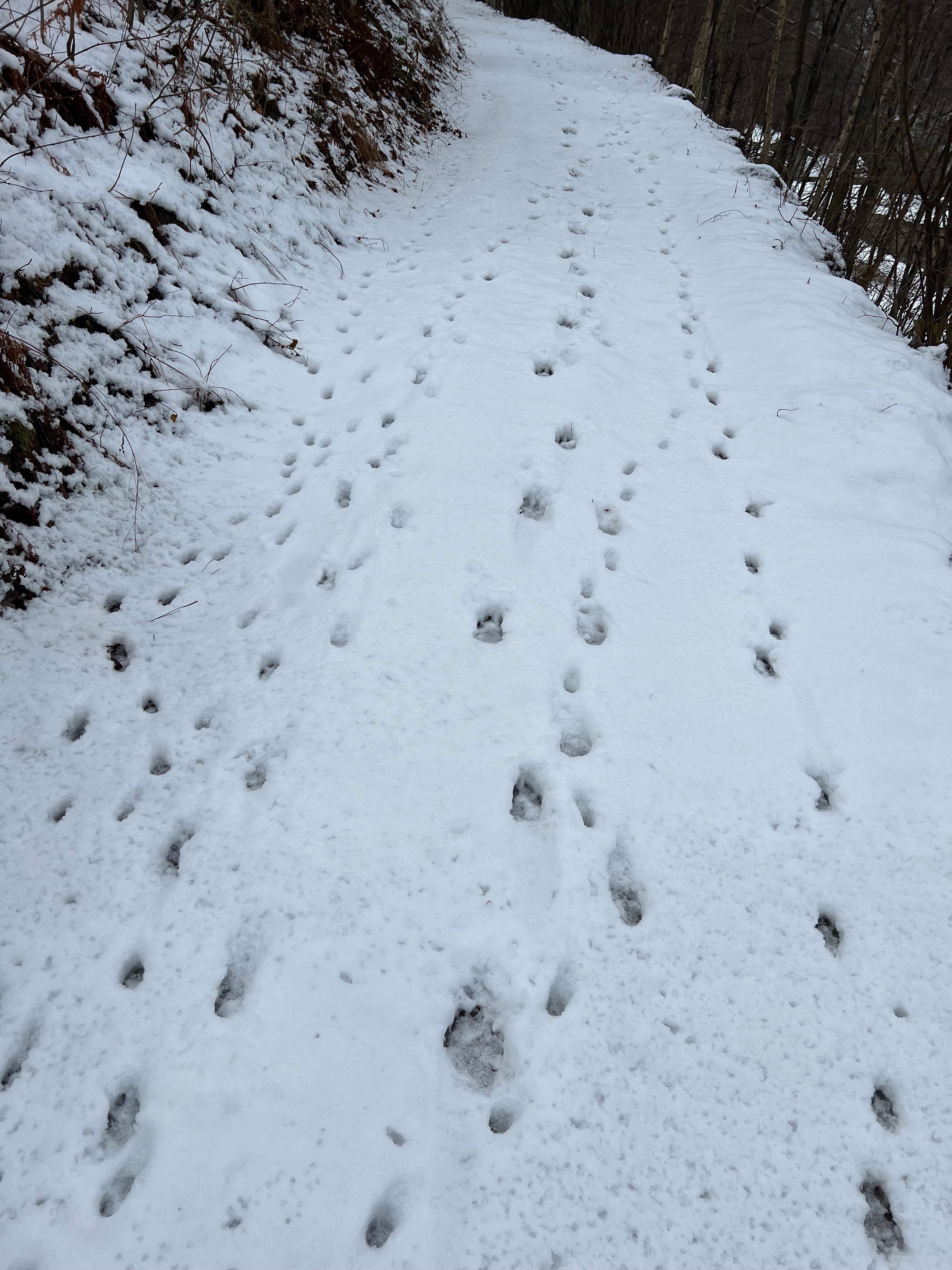
The Mountain was lyrically beautiful in its deep winter landscape of skeletal trees and undulating snow-drifted meadows, mist hanging in dense white pockets, hugging low corners of the valley. To the west, the upper peaks had all but disappeared from view, the snow melding the sky and Mountain into one vast, breathing Winter body, reclining peacefully in slumber. Vehicle tracks, footpaths, streams and waterfalls traced out the Mountain’s venous system in a creeping network of white lines, I had slipped and skidded along one such frosty artery to reach the fontana that morning, struggling to find purchase in the wet snow. Forced to slow my pace and watch the ground, I noticed the delicate capillary network of animal tracks fanning out along the path and slopes, clearly delineating the wildlife corridors normally invisible to all but the practised human eye. Wolves, deer, hares, foxes and feral cats had all passed this way since last night; I traced the meandering lines with my eyes, noticing where a hare had paused to rest, and a fox had turned suddenly on its heels, disappearing back into the woods. The wolf tracks ranged out in a ragged line across the meadow, detailing the movement of a family group emerging from the upper wood line and heading towards the valley basin. The wolves were probably following the scent of my neighbour’s sheep, although the small flock were tucked up in a barn at this time of year and protected by a Maremmano, an Italian breed of livestock guardian dog. Turning around and looking back at my footprints mingling with those of my creaturely neighbours, I reflected on the simple purity of a moment like this on a Monday morning in January, feeling a rush of gratitude for this starkly basic life. As many would be on public transport heading to city jobs or navigating traffic jams driving their children to school, I bent down to examine an unfamiliar paw print among the others (possibly a type of Marten). A different kind of life, no better or worse than any other, but I feel no regret for the one I left behind.
I held the last bottle to the spout of the fontana, wet hands red and raw with cold; I had forgotten my gloves. Collecting water is a meditative task, zen-like in its slow, repetitive movements alongside a soundtrack of gently running water—concentration is required, but in the automatic way that we drive a car, the mind is allowed to wander reflectively. I know that for as long as I stay here, I will come to fill bottles from time to time, municipal water supply or not. It has nothing to do with the purity of Alpine spring water and everything to do with the ritual, precious time for contemplation. I am an early riser and usually sit in contemplative prayer or meditation when I wake; if I leave for the fontana early enough, I can continue my morning practice seamlessly in a slow walk and the effort of gathering and carrying water. To live this way, a life built around simple jobs requiring some physical effort, completed outdoors with calm focus and purpose, both settles my mind and grounds me fully in the human experience. Luxuries for me do not consist of central heating or croissants and coffee to go, although a hot bath with essential oils would be nice, I admit. My rider list comprises everything the Mountain can offer me: sunrises and far-reaching views, the smell of dewy grass and kaleidoscopic spring flower meadows, a breath-catching plunge into an Alpine pool and the glimpse of an Eagle soaring overhead. Above all, the precious gift of time surrounds me here, not in the sense that I have enough of it because I do not. Quite to the contrary, my days are often frantic and carefully timetabled to carry out the work of chopping wood, boiling water to wash and the slow crawl in the car down the track to go to the launderette, fitted in amongst my other responsibilities. But time here is different—meaningful. I can rest and rise with the seasonal light, I can take a moment to pause as the clouds part and gift me a streaked pastelled sky, I can choose to make my phone calls from a favourite rock in a nearby field to observe the pollinators and grasshoppers at the same time. I can tell you exactly how long it takes to fill a water bottle from the fontana at different times of the year when the discharge rate ebbs and flows. I know how long a log takes to burn in the stufa, depending on the variety of the wood and the size I have cut it. I have a mental record of the precise walking time between my cabin and many oft-visited locations: the bridge where I park my car in winter, the recycling bins, various friends’ houses, the rifugio restaurant to buy eggs, my favourite sunrise spot. And I can tell you pretty accurately how much extra time is necessary if the ground is icy or sticky with mud or when summer humidity slows me down. My perception of time is finely tuned in this regard, but my understanding of the passing of time has become less clear. Solitude means that sometimes the days stretch out so languidly as to lead to a sense of aloneness, while at the same time, the business of living alone here can reduce a working day to the blink of an eye, as I have no one to share daily chores with. These disparities only serve to increase my appreciation for every given moment, which I do not take for granted, particularly as I grow older.
Drying my hands on my jeans, I loaded the water bottles into the bag as the snow started to fall faster, thickening rapidly. Time to go before I got soaked. Moving to swing the bag onto my shoulder, a tiny snowflake caught my attention as it settled on the sleeve of my coat. Then another, and another. These were the snowflakes of children’s drawings and Christmas cards—enchanting hexagonal structures, each one wildly different to the next. The temperature was too high to preserve them, and the perfect crystalline forms were melting as soon as they touched my clothes and the stone basin; I barely had time to focus on them before the flakes turned to sleet and faded away. In childlike wonder, I held out my arms to catch them, determined to see more of the fractal-like patterns. Pulling out my phone, I tried to capture them on camera, chasing the snowflakes as they landed and failing every time, one blurry shot after another. I laughed in delight at this game of Kiss Chase; I was the undeniable loser, the object of my desire eluding me. It was perfect. A moment in time well spent, a rare and keen happiness, gone in an instant, leaving only the imprint of memory and wet marks on my jacket. It seemed to me, standing on a snowy mountainside in the Alps, alone on a January morning, that the quickening of the snowfall carried an urgent message important for me to hear. Beautiful things are not forever, I was reminded, and happiness is fleeting. Life is so very short. Time is limited for us; we make of it what we will, but must not delay or deny opportunities as they present themselves. As each and every snowflake that has ever existed is unique, so are we. Our dreams, hopes, passions and loves are as individual as we are. If happiness is important (and I have thought about this a lot, concluding that it is, for many vital reasons), then we must try to catch the snowflake. That means developing an intimate relationship with time, ourselves and whatever else you believe exists beyond us. It also means we have to decide which snowflake we are going to catch, and crucially, we have to believe we are worthy of it. That we deserve to be happy. The memory that stayed with me in the few days between the snowfall and writing about it is my reaction to those precious flakes and what I became in that moment. The child in me awakened, I was utterly authentic, acting without concern of reproach, beyond any programming or conditioning. I was whole, and I was myself. It is said that on our deathbeds, we no longer fear the end of our lives because we feel it close. Instead, we are concerned with the life we have lived. And the worry? That we failed to live in the truth of ourselves and, therefore, failed the human project altogether. Will I dare to be enough me? I wrote recently about being more wolf, but I will revise it, I was wrong, the words I began whispering to myself as I clambered about the Mountain these past days are “Be more Natalya”. A much more terrifying prospect. I encourage you to try it with your own name; it might be harder than you think. This, ironically, is a mature adult’s game. And, whilst you are it, catch the snowflake, or at least give it your best shot. You have nothing to lose apart from looking and feeling like your six-year-old self, a kid in their element, navigating the snowstorm of life—how magnificently wonderful.