

When I meet new people, there is usually a point in the conversation when they ask me why—Why Piedmont, why the Alps, why so isolated, why the Mountain? ‘Finding your Why’ has become a trend in postmodern or transmodern (you choose) society, related to following your bliss or discovering your dharma, getting to the root of your personal development journey, and, essentially, figuring yourself out. I admit, I don’t much like the why question when asked of me. I have caught myself pausing and inhaling, jaw tensing in response. I normally brush it off with a shrug and a jovial “Why not?” It tends to make people laugh, and humour is a great deflector. Moving swiftly on, then. I understand why the why might interest others (apparently, I have made some unusual life choices), but honestly, I don’t find my life very interesting, let alone the reasons behind living the way I do. I already wrote a little about the dismantling of my life that led me to the Mountain, and the prefix re that intrudes into much of our consciousness in midlife as we reflect, rethink, reconsider, revise and reconstruct, makes its point—we look back as we mature, to grow. Then, we make the necessary changes. I just didn’t embody the trope and run away with the milkman or get a facelift. Yet. But in the interest of clearing a few things up, here goes.
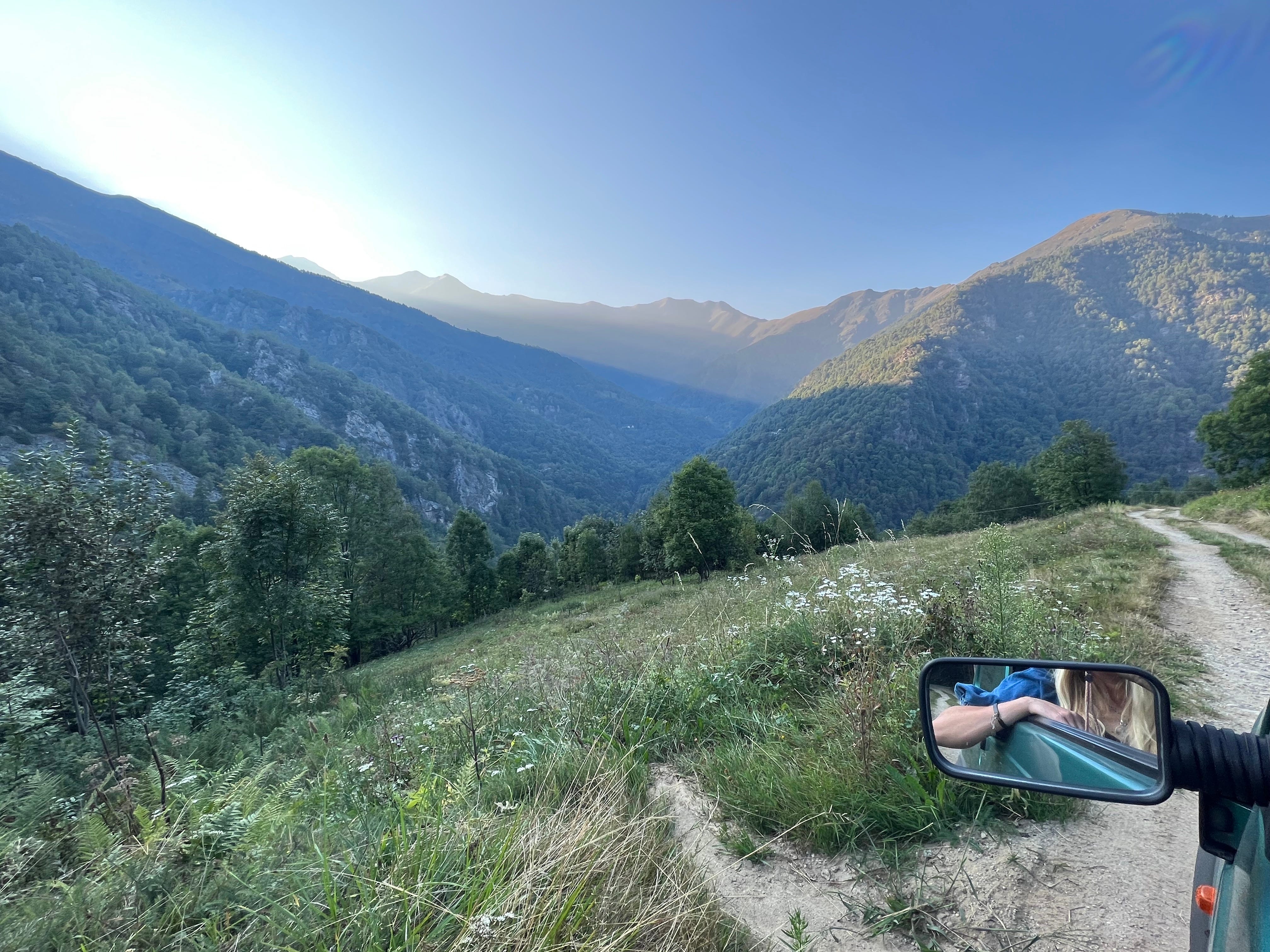
Why Piedmont? Mostly practical reasons related to sharing the responsibility of my three dogs, where geographical location was a factor. Additionally (and this was a subconscious move on my part), this area is essentially the Scottish Highlands on meteorological steroids. Pretty much the same landscape, flora and fauna (wolves and boar aside) but with more sun, more snow, more wildflowers, and more cows with bells on. It feels familiar, and I am comfortable here.
Why the Alps? I love mountains, I always have. I spent every childhood holiday hiking in the English Lake District or the French Alps, and I feel better at high altitudes—more vital and alive. I thrive on a mountain view and breathe more deeply in the Alpine air, literally and figuratively. When Rainer Maria Rilke described breath as “an invisible poem”, he was surely writing from a mountain peak in the Alps.
Why so isolated? I wanted peace. I needed solitude and craved the space and silence that a wild place offers. I wouldn’t have found that in a village or even a borgata (hamlet). Coincidentally, I’m a bit of a loner, content in my own company. As a child, I was self-contained—happiest in the woods by myself, reading voraciously and writing and drawing obsessively. An introverted extrovert best describes me. Not everyone could live the way I do, but it suits me just fine.
Why the Mountain? Well, it was always going to be a mountain for the reasons described above, but why this mountain? That’s a more interesting question. If some things are meant to be, then I could tell you that the Mountain intended to give me permanent shelter from the outset. My first visit brought me here to talk to now neighbours about permaculture; it showed itself again with a beckoning finger in my property search, and finally, months later, I hiked up the mid-slopes one clear February day to stand outside my cabin for the first time. The buildings were locked because the agent had refused to accompany me in the snow, thinking I would be put off by the rough dirt track, half-ruined buildings and lack of electricity or water. I had been written off as another idealistic foreigner without the gumption or the funds to buy a place like this, a time waster. If common sense had prevailed, I might have shaken my head and walked away—the property was the wrong aspect, not as private as I would have liked, and I would not own all the buildings in the courtyard. This last point would be the most complicated downside of all a year later. It was too late, however, the Mountain was wrapping its arms around me and holding me with a loving gaze, tenderly recognising me as one of its own. Muttering, “I can make it work”, I paced the land and around the buildings; the property met most of the requirements on my spreadsheet. I knew it was mine. What I didn’t consider at the time was that perhaps the Mountain had been the one claiming me all along. There is an inevitability about this place in the sense that fate and destiny are intertwined, becoming purposeful. The first glance became the beckoning finger into a bear hug, finally turning into a soft caress (although there have been a few lover’s spats since). This was always going to be the place that changed my life in every way imaginable. Unbeknownst to me then, of course, but the wizened thirty million-year-old Mountain knew it all from the beginning.
When I was negotiating the sale of the cabin, I brought a friend with me one weekend to see it. She jokingly called it Magic Mountain, a nickname that stuck as we messaged back and forth in the weeks afterwards. One April morning, a month later, I was listening to the radio when I received the news that my offer had been accepted. As I opened the email, read the first line and threw my hands into the air with an exuberant “Yes!” the broadcaster announced the next song, an old soul track called, you guessed it, Magic Mountain. A song I was unfamiliar with but saved to a playlist, it was part of the soundtrack that accompanied me on the day I signed the deeds, driving along the curling valley road towards the Mountain, hot, dishevelled and happy. If you believe that certain synchronicities are the supernatural nudges that give us a knowing nod or wink when we are heading in a significant direction, then someone hammered a signpost deep into the rocky ground, hand-painting my name and the destination on it: Magic Mountain (2121 m).
And the real reason why I don’t like the why question? Because I don’t have all the answers. As much as an enquiring mind is important, sometimes the logic of why needs to be set aside in favour of a beginner’s mindset, open and eager to the wondrous unknowingness of life as we see the Magic Mountain come shimmering into view on the horizon. It really can be that simple—some experiences, places and people are just meant for us.
Note - Reflecting on this piece, I realise it is more than what one might call a pensierino (little thought). More than a postcard but less than a letter, it still fits pensierini better. Perhaps I should be bolder and rename the section pensieri (thoughts). I have never excelled at crafting concise pieces, writing as I think—a babbling brook. I will think on it.